

What do we have that AI doesn't?
Thoughts on the evolutionary advantages of being human

Since ChatGPT went viral in late 2022 I’ve been hearing more and more prominent voices in science and technology suggest that soon AI will be so clever that it makes us humans obsolete. Some have even gone as far as to suggest that in a Darwinian “survival of the fittest” contest, the machines will be so superior as to not just take our jobs, but actually replace our species in the process of evolution.
Elon Musk tweeted (or am I supposed to say X’d?) in April this year that “it increasingly appears that humanity is a biological bootloader for digital superintelligence”, suggesting that our purpose in this cosmic existence was just to invent the AI.
Then there’s philosopher Nick Bostrom writing that:
Machine intelligence is the last invention that humanity will ever need to make. Once we have machine intelligence that is more intelligent than humans, it will take over the process of inventing. It will be a new species, in a sense, an evolutionary successor to humanity.
And author Susan Blackmore recently wrote that:
We humans are in trouble. We have let loose a new evolutionary process that we don’t understand and can’t control.
While some are excited about the intoxicating power of AI to transform business and others are worried about how it will affect their livelihoods, these ideas take the conversation up a level to the frame it as a question of evolution, a game that most humans of our era seemingly assume that humanity has already won.
I’m going to be honest, I am skeptical as to whether AI does, or can ever, constitute a ‘species’ from an evolutionary perspective, but I also accept the fact that until we figure out the nature of consciousness we probably have no definitive way to be sure. Nevertheless, the question of evolution got me wondering, if AI (together with robotics) does become a competitor species to humanity, who would actually turn out to be “fitter” from an evolutionary perspective?
Last week while bouldering at the local climbing centre, I saw the wonder of the human species on the walls all around me and suddenly realised that the tech hype largely overlooks so much of what makes human beings so amazing. In fact, the question of what makes us human (which I wrote about last year) brings into focus a lot of what we take for granted about ourselves and our species.
Today therefore, I thought I’d share just a few things that I think make humans fitter than machines in the game of evolution, not to inflate our egos, but to give us a boost of inner confidence and remind us that we are not machines.
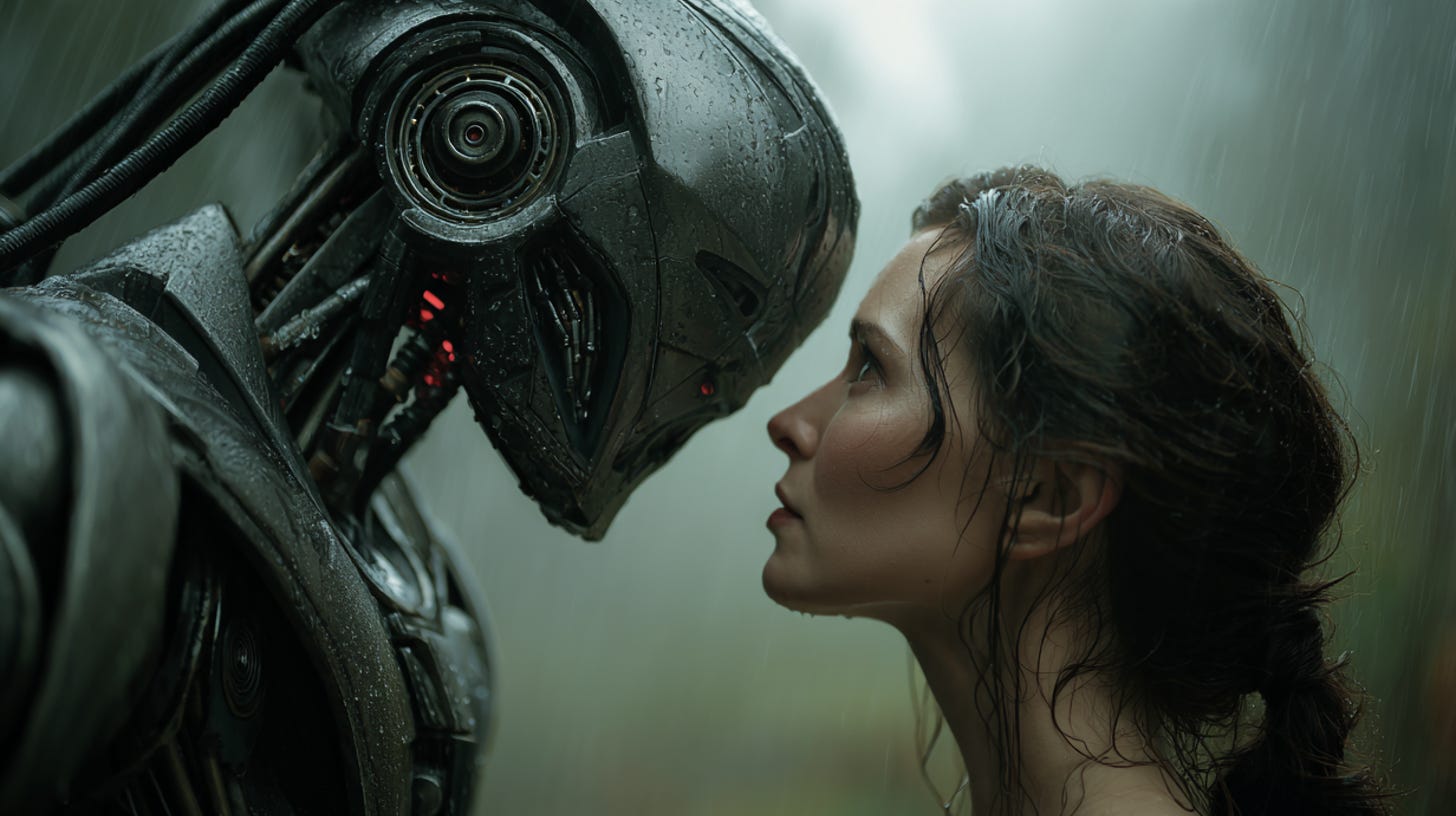
Adapting to change
One of the biggest challenges presented by AI at this time is how fast it threatens to change our lives and society, making it hard for us to get our heads around where we are going and how to adapt. Hidden within this cloud of anxiety though is the reality that we will adapt. Our ability to adapt is perhaps one of the greatest strengths of humanity and this time will surely be no different. That doesn’t mean that it won’t be hard at times, but that on balance we will rise to the challenge.
Charles Darwin is often paraphrased as saying:
It is not the strongest of the species that survives, nor the most intelligent that survives. It is the one that is most adaptable to change.
This is worth noting, because it explicitly says that it is not the most intelligent species that survives. I have no doubt that computers will be more intelligent than pretty much all humans very soon, if intelligence is defined as cold hard computation of information, but that’s not the most important thing.
While many people will suggest that computers, and particularly artificial neural networks, are highly adaptable, this might not be as true as we think it is. Sure, you can throw a wide range of tasks at an LLM and it can do a decent job, but it’s doing that off the back of huge numbers of human experiences that it has learned from. Throw it into entirely new situations without giving it a dataset of human experiences and responses, and we might see more clearly how adaptable they really are.
To give an example, to drive a car safely on the roads, Tesla has accumulated data from nearly 4 billion miles of humans driving cars, and it still hasn’t learned to drive a car in the way that a human has. And yet most 17 year olds can learn to drive a car in less than 100 hours at the wheel, without needing data from 4 billion miles of other people’s driving experiences. And once they’ve got the hang of it, you can throw them into weird situations down country lanes with donkeys and cyclists, and somehow they figure it out (most of the time).
That’s not to mention the fact that we are physically adaptable, not just mentally. We can drive cars, walk to the shops, climb on walls, write with pens, cook food, and get our arms into really awkward spots under the sink to fix a leak. Oh yeah, and we’re waterproof!
Self-charging infrastructure
One of the big criticisms of AI at this time is the huge amount of energy that it needs. From an evolutionary point of view, this is a fundamental problem. The human brain uses only about 20 watts of power, which is less than a typical laptop computer. To run the whole human body requires us to eat about 2000 to 2500 calories of food per day, equivalent to about 3kWh of energy for a particularly hungry adult. That means we’re consuming an average of just 125 watts. For context, that’s a third less than a Dyson V6 cordless vacuum cleaner, which runs out of batteries after 20 minutes or less.
It is conceivable that a humanoid robot could be developed that uses the same amount of energy as a human, or maybe even less, but that wouldn’t include the telecoms networks or data centres that are fundamental to their apparent intelligence. Humans are incredibly energy efficient.
But perhaps even more significantly, we can charge ourselves up on an enormous variety of fuel sources in a huge range of environments, from a wild herb in the desert of Arizona, to the milk of another mammal, to a Mars bar at the local corner shop. Computers (including robots) can’t eat anything apart from electricity, at a very specific voltage. They are very fussy eaters.
And of course the elephant in the computer room is that humans are instrumental in the lengthy supply chains that produce that magical electricity on which they depend. While we might be highly dependant on modern infrastructure ourselves, humans can survive without any artificial energy source, and that gives us an incredible amount of resilience.
Out of warranty
One of my big frustrations with modern electronics is how fragile they are. Rarely does any device these days last more than a few years, with many devices irreparably failing not long after their warranty runs out. Of course, much of this is due to the fact that modern products are designed to have a limited lifespan so that we keep coming back to buy more, but it is also because electronic devices are fragile things.
A typical human can live for about 80 years, even pushing over a century from time to time. Even in terrible conditions, average life expectancy for a human far exceeds that of your average computer, partly thanks to the fact that we have the magical ability to self-repair. We can cut our fingers, contract a disease or break a bone, and we are able to heal ourselves, in the majority of cases growing the replacement parts from inside of ourselves.
Computers and robots cannot heal themselves other than perhaps getting a software update from a fellow machine, and as they become increasingly miniaturised they become harder to repair, with humans being the lifeline to provide the parts, if replacement parts exist at all.
And when it comes to the brains of the operation, a single ‘bit’ of information out of place at the root level of a computer can crash the entire system. Human brains on the other hand, misfire all the time. This might not sound like a great feature, but it illustrates the fact that our brains are incredibly versatile and resilient, constantly rewiring to heal errors and optimise performance.
Plenty more where we came from
We can’t really talk about the evolution of any species without talking about breeding, a thing that humans seem to be very good at. Machines on the other hand have no way to reproduce themselves, a problem compounded by their fragility and short lifespans.
If they were to reproduce themselves without help from humans, they would have to take control of every single piece of the entire global supply chain for every one of their own components, mastering the abilities to mine, transport, manufacture and assemble everything. This might require the development of specialist robots for specific tasks, but having designed them, the computers would then need to set up and operate the supply chains to manufacture those additional new robots.
In fact, the huge amount of work that humans put in to operating our global supply chains and the huge environmental strain resulting from those industries highlight the immense inefficiency of technological reproduction compared to biological reproduction.
The human experience
Perhaps the most under rated thing of all in the AI conversation is the value of the human experience itself. It is after all the very thing that all modern AI systems are trained on. Even when they use ‘hard’ data such as readings from sensors, humans have had to go out there into the physical world to install those sensors and connect them to the data networks.
Of course, robots will increasingly be able to explore the physical world and gather data directly with their own sensors, but their lack of physical versatility will likely always limit where they can go without human supervision.
But that’s not the most significant thing. The most significant thing is that even armed with a load of unique sensors, they don’t actually have the ability to experience what those things feel like. They have data, not experience. They cannot perceive the beauty of a rose, or the love a parent has for their child. This soft data, this qualia, is what life is really all about and it is central to our richly layered intelligence. Computers will of course be better at maths than us, but they will never understand why that matters. They will never be wise, even if they do a great job of mimicking the wisdom of humans in their training data.
This human wisdom is often also guided by invisible forces through intuition and spontaneous creative insight that leads to outcomes that brute force computation of existing data could never get to. These inexplicable leaps in thinking, creativity and understanding are a key part of evolution itself. Without that, we would stagnate, and without us constantly feeding them fresh ideas, the computers too would eventually run our of material to iterate on.
Some will say that this doesn’t matter, but no matter how insane our modern society might appear from many angles, I’d suggest that human wisdom is one of our most powerful assets and will be central to the creation of a positive future, not just for humans but for the machines too, if they want to join us.
And so much more
I feel like I’m barely scratching the surface here in what makes humans uniquely special when compared to machines and why we have huge evolutionary advantages if there ever was a need to compete with them for our place in the world. Artificial Intelligence and robotics no doubt pose risks for humanity, but those risks likely have more to do with the humans behind them than any real evolutionary advantage.
Humans are incredible things, and instead of looking at ourselves as ‘meat robots’ being threatened by shiny new aluminium models, we should take the time to look deeper within ourselves to see what makes us special and how we can harness our full potential for the betterment of humanity, and all of the living world. If we do that, we might just find better ways to adapt our lives, careers and businesses to the rapid change that AI is bringing our way.
And as a final note, I just want to reiterate that all of the posts you read here on Oxymoron are written by me, Tom Greenwood, an actual human. Some of you might not care, but to me writing is a craft that I love, and somehow I believe that there is an undefinable value to knowing that what you are reading is the words of another human who wanted to share them with you.
So thanks for reading. Please do share your thoughts in the comments and share this post on your favourite platforms if you found it interesting. I’d really appreciate that.
Another trait we have that gives us an edge over the machines is unpredictability. The surprise effect of connecting two ideas that don't belong together, of making an irrational decision, of doing the wrong thing for the right reason.
These machines work on probability. They can only guess what comes next based on what came before. Compare that with a dream or a gut decision.
I like how you mention that we still fully control the systems AI runs on. If we need to, we could plug the machines out.
But I wonder, will there come a point when AI identifies the kill switch as a threat and disconnects itself from the switch to prevent us from switching it off. In the not-so-far-fetched scenario where AI decides the biggest threat to life on Earth is the human species and attempts to manufacture a virus to wipe us out.
(Sorry – I couldn't help ending on a frightening note : )
Loved this, Tom. Such a needed reminder that the magic of being human isn’t in how much we know but in how deeply we experience. Adaptability, creativity, emotion.... we’re still the best “operating system” evolution ever designed 😊 Thanks for sharing!